

More Than a Desert: What the Negev Taught Me About Resilience, Coexistence, and Care

There is one place in Israel that perpetually calls to me. One visit isn't enough. When can I return?
In November '25, our joint cohorts boarded a bus to the Negev Desert in the south. Our action-packed itinerary showed us the beauty of humanity and nature. Yallah!

The story begins in the middle.
An overnight trip. We arrive at lovely Sde Boker after dark and check into our hostels. Sunrise yoga is planned for the following morning, and though I can't find the other participants, I do find one of the most glorious sunrises I've ever seen. I sprawl a yoga mat there by the rocks, overlooking the immense, sprawling canyon, and appreciate one of those yoga sessions that just makes you happy to be alive.
As the sun emerges above the horizon, so do the ibex goats emerge above the cliffs. Walking in small family units, or individually, they graze in the rocky fields, unfazed by the people around them. Eventually, they congregate in huge groups, chilling. Occasionally, you find one standing on a rooftop.
After breakfast, the sun still steadily climbs. Meanwhile, our bus descends into the lower layers of Ramon Crater of Mitzpe Ramon. No, it's not actually a crater. It is the amazing product of ancient eons of erosion, a pit carved by the great sea and river that used to flow through what is now a desert.
Our group crunched through the rocky, dried-up river bed trails. It's a popular hiking spot for groups, and it's also part of the cross-country Israel National Trail. We hiked for a couple hours with multiple stops for water, snacks, and, of course, pictures.

Here are a few glimpses of the trail. Notice the layers of minerals in the rocks. Each band tells its own story.
What struck me the most was how much plant life survives in the desert! You'll notice plenty more life if you're patient and observant.
Let's snap back to the first day of our Negev trip, to Project Wadi Attir, an agriculture center that blends modern science and technology with the traditional Bedouin practices of farming. We took a tour of the facility, around the livestock farm and the medicinal plants plots.
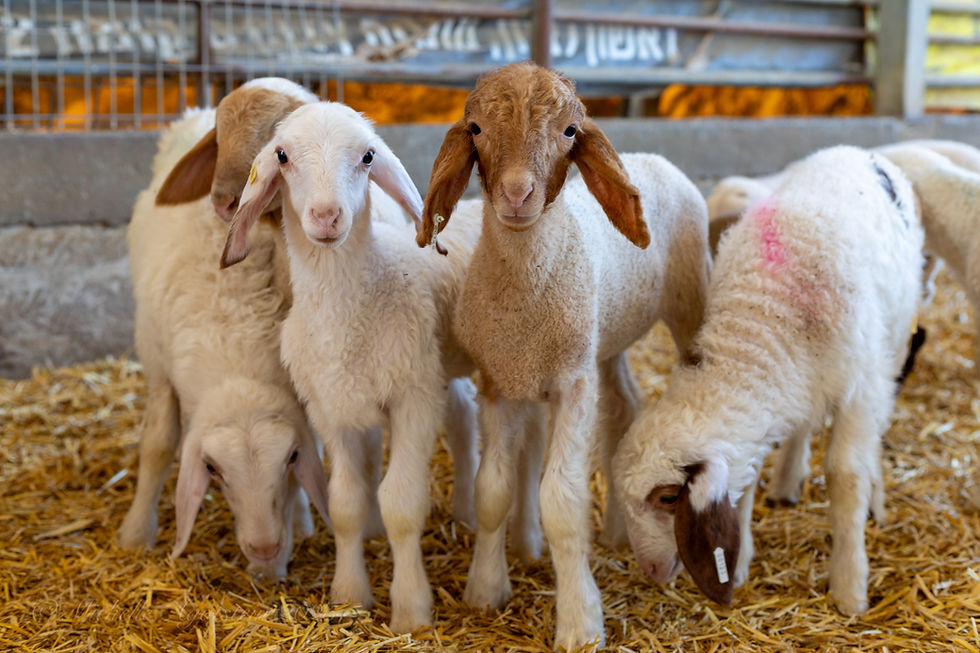
The Bedouin are a traditionally nomadic group of Muslim Arabs. They have a deep connection to the land of the Negev, with a timeless talent for survival in the desert. Their expertise revolves around animal husbandry, crops, water management, and foraging. It's amazing when you realize that the Negev accounts for about 60% of the land mass of Israel and that most of the nation's agriculture is produced there!
Besides agriculture, the dairy from Wadi Attir is known to be top-tier.
One of our own in MITF (Masa Israel Teaching Fellows), Ben, studied Arabic in university and was able to hold a conversation with some of the staff at Wadi Attir. Even as we were being herded back to the bus, it was difficult to tear them out of conversation. So, a photo for posterity, as it'll last longer than the chatting was able to.

Organizations in the Negev, including this one, are challenging the traditional roles of Bedouin women, who are marginilized and face several cultural and societal difficulties, in regards to education, work, discrimination, and more. Here at Wadi Attir, eco-tourism brings visitors, contributing to the progression of breaking barriers and stereotypes that traditionally hold women back.
Ok, back to the adorable animals!
In the heart of the Negev, there is another incredible facility, but this one is devoted to the most vulnerable members of Israeli society. Welcome to ADI Negev-Nahalat Eran Rehabilitation Village!
ADI is a fully accessible rehab village for anyone, from children to adults, with severe disabilities. The amount of care and love you feel in the facilities is striking, and it flows through the endless rehab solutions that are offered to proverbally and literally get people back on their feet again.

There is a strong social component present in the community, beyond just the compassion that you feel within the staff and family members there. It's strength in an idea, a (proven) psychology, that community pushes people to be better, for themselves and for the others around them. That's why you will often find residents receiving care within proximity of each other, with full visibility of each other. For example, you may find a child receiving hydrotherapy in the pool paired with a soldier or a high-tech entrepeneur. One sees the other trying, even succeeding, and it fosters one's drive, empathy, and acceptance.
What kind of facilities are available at this center? Where do I even begin? A special education school, farms, a hospital, sports therapy and hydrotherapy complexes, residences, a horse therapy stable, a petting zoo, fully accessible playgrounds, and more!
The staff at this complex are some of the most warm-hearted, caring people you'll ever meet. Many of them are current or former patients/residents of ADI.

In the center of Israel, around Tel Aviv, if there is a rocket launch, you have about 90 seconds to get yourself to safety in a bomb shelter. At ADI, this close to Gaza, you have 7 to 8 seconds.
You can imagine how close the rehab center is to the border of Gaza and the miracle that they were spared from any attacks on October 7th. Our guide, Eli Klein from the Marketing & Communications department (one of the greatest storytellers I've met -- please go take a tour of the campus with him), painted a stark picture for us of how tragic it would have been if Hamas had reached ADI that day. And somehow, thankfully, they didn't.
One of the staff members at ADI had left work, and five minutes' drive from ADI, she was attacked and killed by Hamas terrorists. And yet, everyone on the campus was safe. It's a huge campus that employs Palestinians who commute from Gaza (or used to). There's no way that they didn't know it was there. Why it was spared -- by choice or the protection of a greater power -- is an unanswerable question, but thank goodness it was.

We move from one farm facility to another, leaving ADI...
...and entering the Ramat Negev Agro-Research Center, another facility devoted entirely to the production of crops on arid land. We took a tour around a plot of olive trees, discovered the secrets to the delicateness of water management in the desert, and got a glimpse of the impressive Ashalim power plant. Our guide imparted with us not just knowledge but also stories of David Ben-Gurion, sharing with us a book that the legendary man had autographed for him before his passing.
Remember how we began our adventures at a hostel in Sde Boker? Here we are again! (Don't get whiplash from all this chronology-jumping.) We concluded that first day with a concert by Avichai Hazot and Tobi Friedman-Tabak, residents of Yerucham, who performed traditional ethnic music genres for us before inviting some of our own MITF Fellows to participate in the concert.

Our two-day trip through the Negev concluded with a particularly special visit to Rachme Bedouin Village, where we met a very special woman named Bhita Sagaira.
Earlier in the afternoon, we'd met a Jewish woman in Yerucham, Deborah Goldman-Golan, who commits herself to "tikkun olam" (fixing the world) and bridging the gaps between Arabs and Jews in her community. During our visit with her, she'd told us of an amazing woman named Bhita, who she's worked with to progress through these pluralist goals.
Our charter bus must have looked quite strange, a sore thumb, traversing through the dirt roads of Bhita's village. We parked in front of her house and joined her in the tent adjoined to her house. Hanging on a wall was an Israeli flag, and arranged in a circle were chairs. We took our seat to listen to Bhita confide in us her story. She held her hijab tight to her head and shrouded herself in a scarf to keep warm that cool November night.
Her story began with her first husband, at the age of 15. She received the rare permission to divorce, as the marriage had been quite bad. She remarried to her second and current husband at the age of 16. She was the second wife to both men.
Her second husband's first wife had taught her to read and write. Proficient and adept, she was able to read the entire Quran within her first year of literacy. It was also under the tutorship of that woman that she had become especially religious. For eight years, she wore a niqab and avoided contact with any men who weren't her husband.
She said she had been this religious for eight years. What changed? Tragedy. Her parents were murdered by ISIS terrorists in Egypt. It didn't break her belief in G-d, but it shattered her perspective, and she began to look at life in a new light.
In her 20s, she decided to pursue an education. She sought a teacher. She was told that a private teacher could be provided to her if she gathered a certain number of other women from her community who wanted to pursue their academics. It was from that point that she became an advocate for women's education, for which she received great push-back from her community, even the women, who asked her, "How dare you try to change society?"
She suffered greatly for this -- mentally, emotionally, and physically. The social pressure against her is difficult to imagine. But she felt a calling to it, that it was her responsibility. Today, she still devotes herself to education for girls in her community. Her home is one of the only ones that consistently has electricity, so she keeps her home open for girls to come study under constant light and to use her computer. She raises a boy and a girl of her own, and although her husband provides an income for their family, he is not present in their lives, so she raises the children as, essentially, a single mother. And she encourages her children to pursue any dreams that they would like. Her daughter wants to study psychology in university, and her son wants to be a professional football (soccer) player.
Her neighbors have eased off on bullying her so much for advocating for women's rights, but she now receives death threats for the Muslim-Jewish advocacy work she does. Rumors fly that she will convert to Judaism (unfounded rumors), and she is told she will be killed if she does so. She obviously will not. But you can see the difficulties, complexities, tensions, and necessity that are present for the valuable work she is courageously doing to make her community a better place. There is much work to do, and it cannot be done by just one person. But one life affects several. And we can see how much change begins with just one big, brave step in the right direction.
I remember my first-ever trip to the desert. My tour guide had encouraged us to look past the seemingly empty, dead space and observe the life. There's more than meets the eye. Life is all around us. It takes different forms, and it is not always pretty or easy, but still, it is beautiful. Past the sand, I see hope.


Comments